Painting without an audience: Jamie Muir’s art works 1981 –2025
by Delpha Hudson
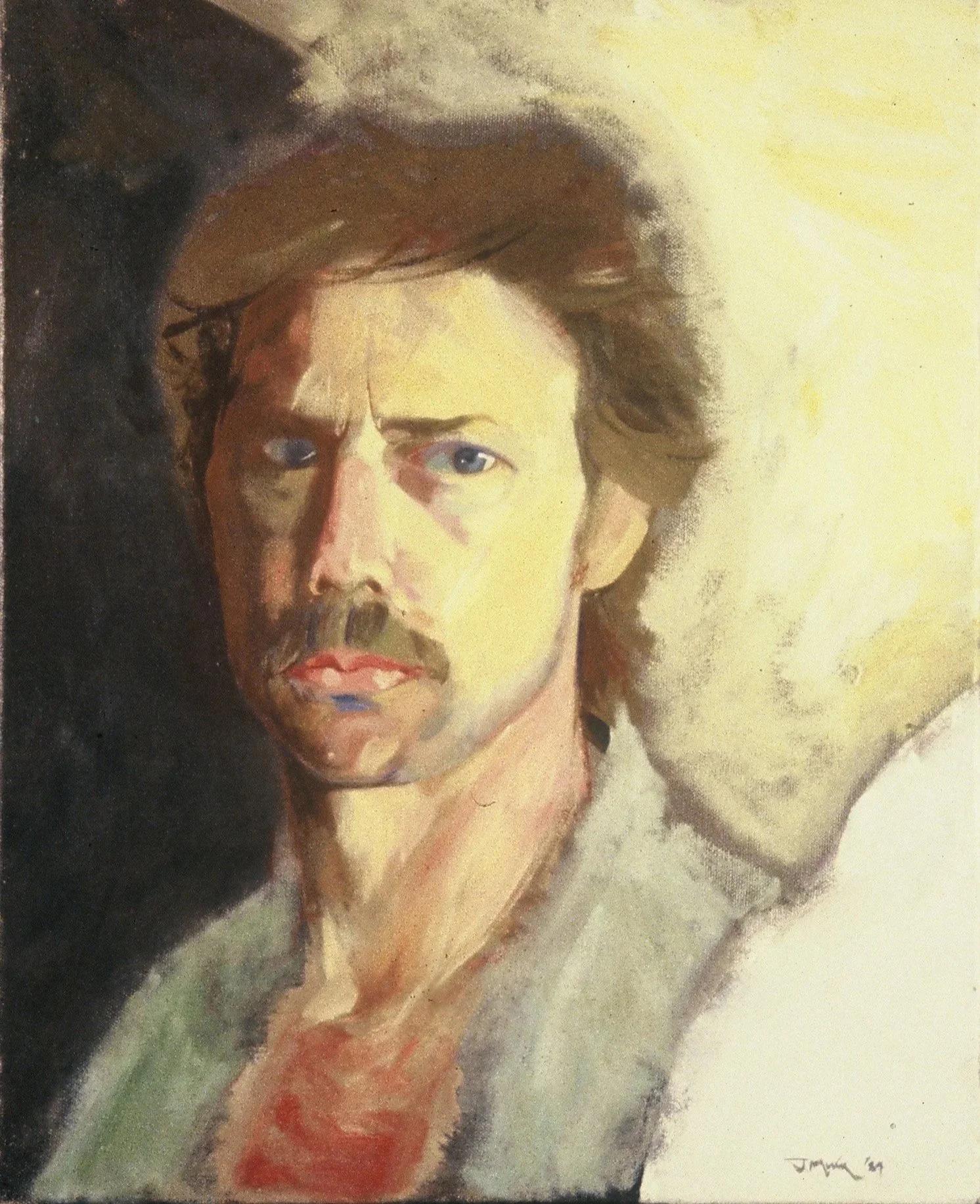
William James Graham Muir (1945- 2025)
Painter and musician, Jamie Muir is famous for his music with King Crimson (1972-1973) and their Lark’s Tongues in Aspic album. A percussionist who was deeply committed to ‘free music’ and improvisation, this brief period of Jamie’s life eclipsed 40 years as a visual artist. What is common to all the newspaper and ‘zine articles are Jamie’s music strikingly intelligent statements about improvisation and his creative process of making sound. Jamie also wrote extensively about art and this helps us to address his legacy as a painter.
In 1973, just before King Crimson’s next tour, Jamie left the group to become a Buddhist. He had met Jon Anderson, singer in Yes, who had given him a copy of Paramahansa Yogananda’s book Autobiography of a Yogi. This book completely changed his life and for the next 7 years he lived as a Buddhist monk in Scotland, Nepal, India and France. Jamie expressed an enormous regard for Buddhist philosophies, some of which later informed his art practice. He had found a lot of peace through meditation, yet in written reflections he also wrote with some misgivings about his experience saying he wanted to live a life independent from others’ interference, and feel free to think his own thoughts:
You don’t need gurus, you need courage1
In 1981 Jamie left the Dordogne where he had been working in a Buddhist community and travelled back to the UK to recover from physical illness and mental distress, saying ‘my body took over and I just fled…’2
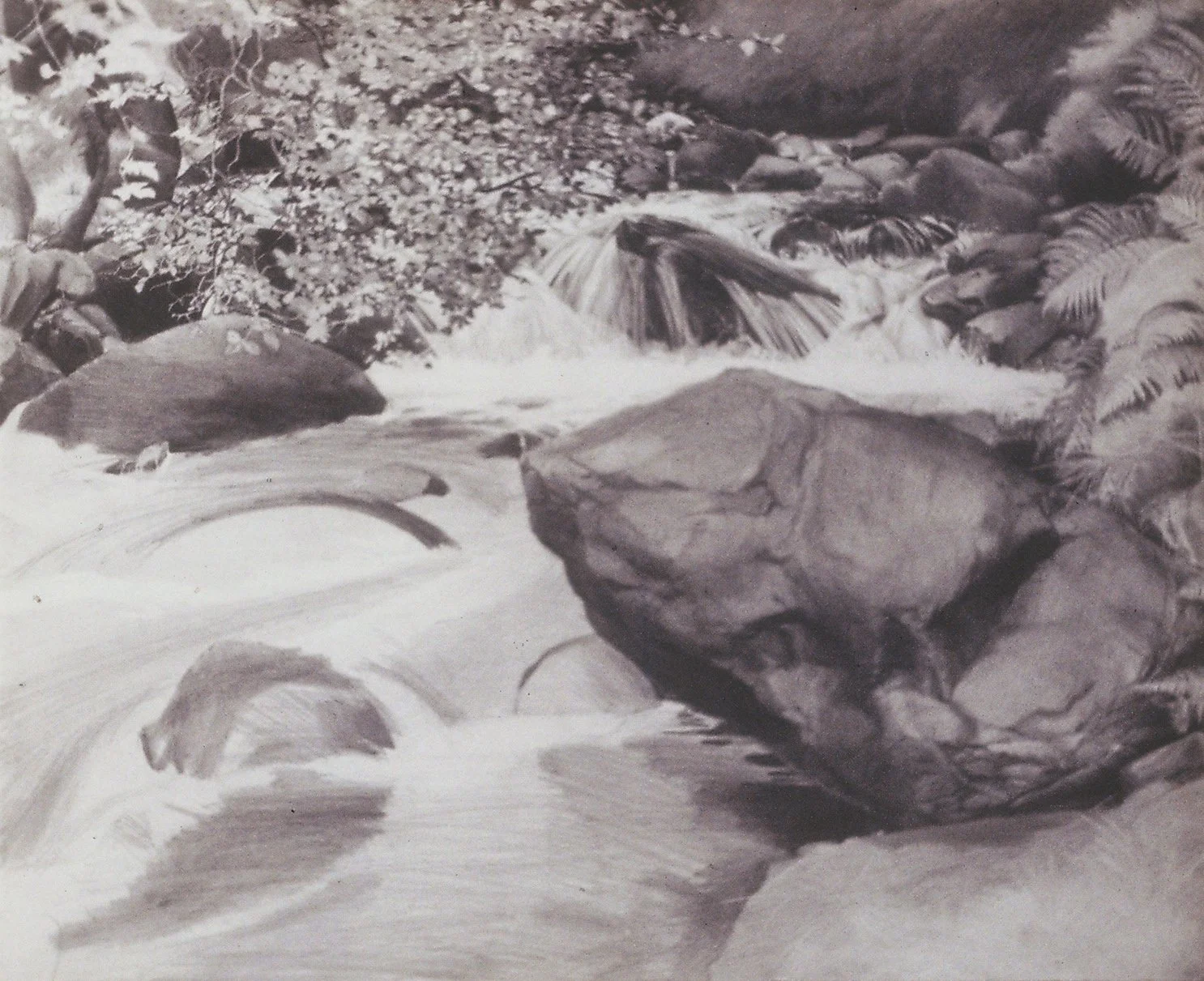
Detail of landscape drawing made in Gairloch 1982
Back in London in the early 1980s, he returned to performing a little music3 but he was determined to return to his earlier passion for making art4. On holiday in Gairloch in Scotland with his family, Jamie disappeared everyday to make intricately detailed pencil drawings of the landscape. Displaying incredible draftsman-ship and an eye for detail, a series of these landscape drawings were shown and sold at The Mile Gallery, 156 the Commongate, Edinburgh (1983). During this period he also started making large pencil portrait drawings were shown at other exhibitions at the Cambridge Fringe theatre, and a three man show at Hugh McIntyre Gallery, Dumfries (1988-9).
By 1988 Jamie had decided that he was struggling with his time and attention divided between music and painting. All too aware of his need to focus, he said ‘I'm not the type to do music half-heartedly; if I'm going to do it, I want to give it 100%,’5 and the same was true for art. Jamie gave up ‘music as a profession. …It was counterproductive to continue doing both’, saying that ‘I am a painter now’. In the same year Jamie made a trip to the USA for 6 months ‘for the purpose of painting’ where he ‘painted all the time’6.
He spent over 40 years in London and Penzance making art that was often inspired by improvisational techniques
Clouds (title unknown), oil on canvas, 102x76cm
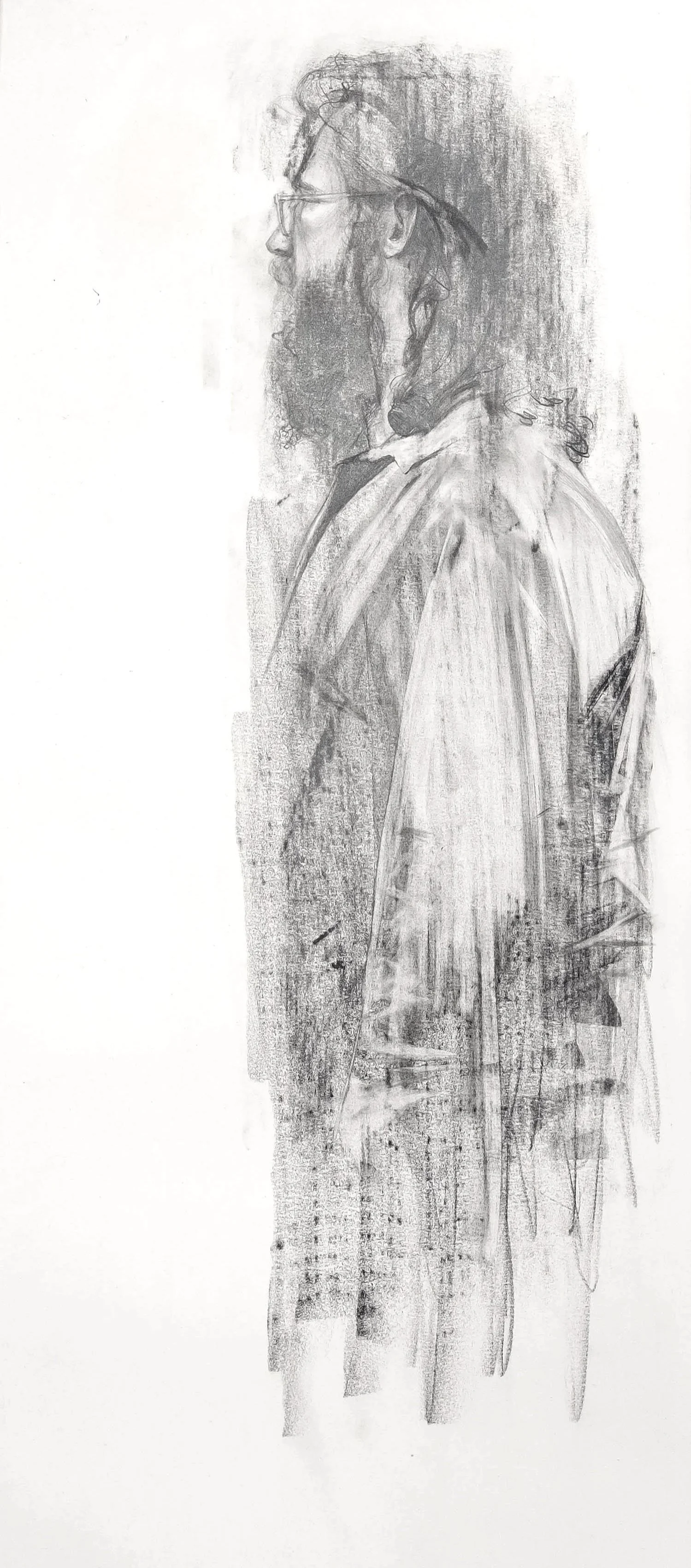
Self-portrait, pencil and charcoal drawing c.1984
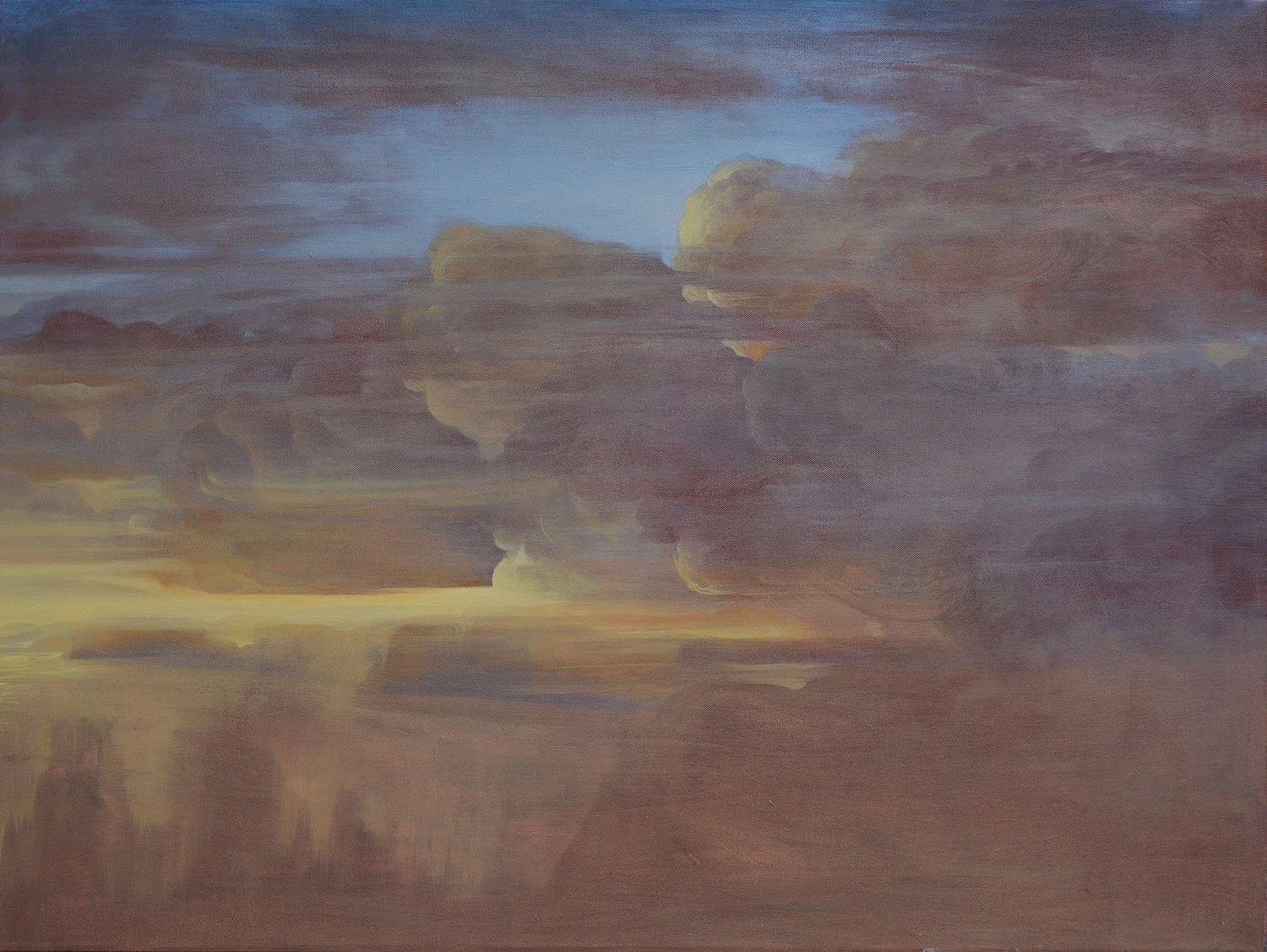
When he returned to Islington in London, with a flat filling up with very large colourful abstract paintings, Jamie created a new studio space by building a shed in the garden. Always a keen photographer, he took hundreds of pictures of clouds on Hampstead Heath, sourcing material for paintings. He also photographed and sourced figures for paintings by photographing them from the television. See you next time in Tibet (1992) is an example of Jamie’s unique combination of an abstracted ‘poured’ painting technique with realistic figures.
Constantly experimenting, Jamie painted large oil and acrylic canvases of abstracted layered forms, sometimes with glitter. He used many different ideas and strategies to create instantaneous expression and then explored different combinations of layers, sometimes with colour, landscape features and figures. The largest of Jamie’s paintings were what he called ‘poured’ paintings.
Acrylic paint was simply poured onto the canvas to see what chance elements might arise. Jamie was fascinated with our human tendency to attribute faces, figures, landscape features to random stimuli, our pareidolic tendency to see a pattern in anything.
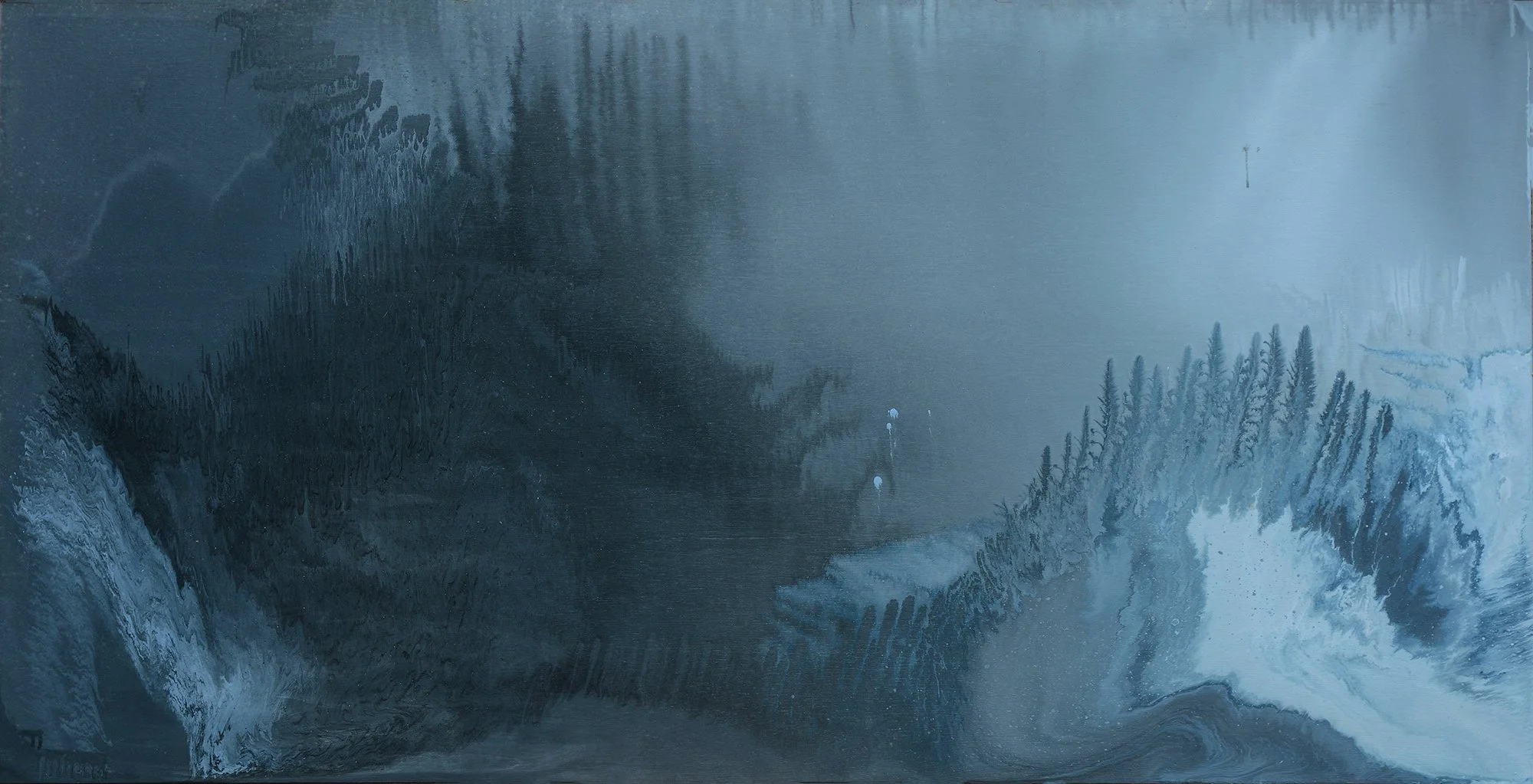
Grey pour I, (title unknown), acrylic on wood, 239x122cm
These abstract landscape-like paintings were intimately connected to his ideas about improvisation and an expressive process of forming imagery through the element of chance. Jamie made technical notes about colour and materials, and refers to them as ’flow-field’ paintings, comparing them to his ‘black and white paintings’ that he said were like ‘info-flow’ paintings that differentially contained a ‘flow of information’7. These graffiti-like black and white paintings are filled with chaotic cartoon motifs. They contain layers of multiple historical references that could be said to be imbued with information, and therefore could rightly be called ‘info-flow’ paintings.
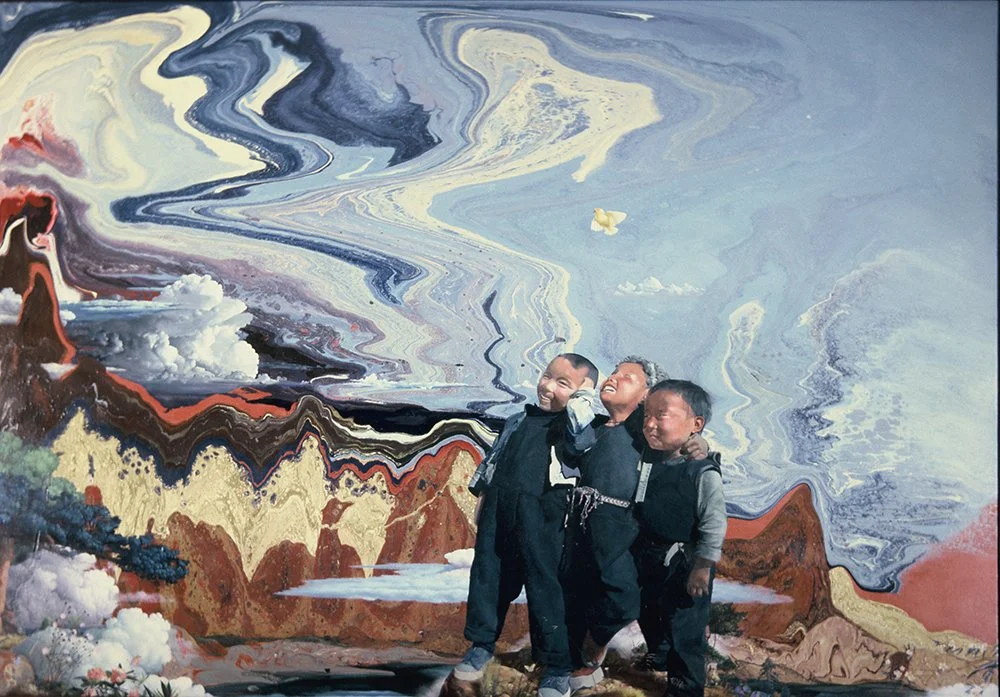
See you next time in Tibet, ‘the one with the kids’, 4’x5’, 1992
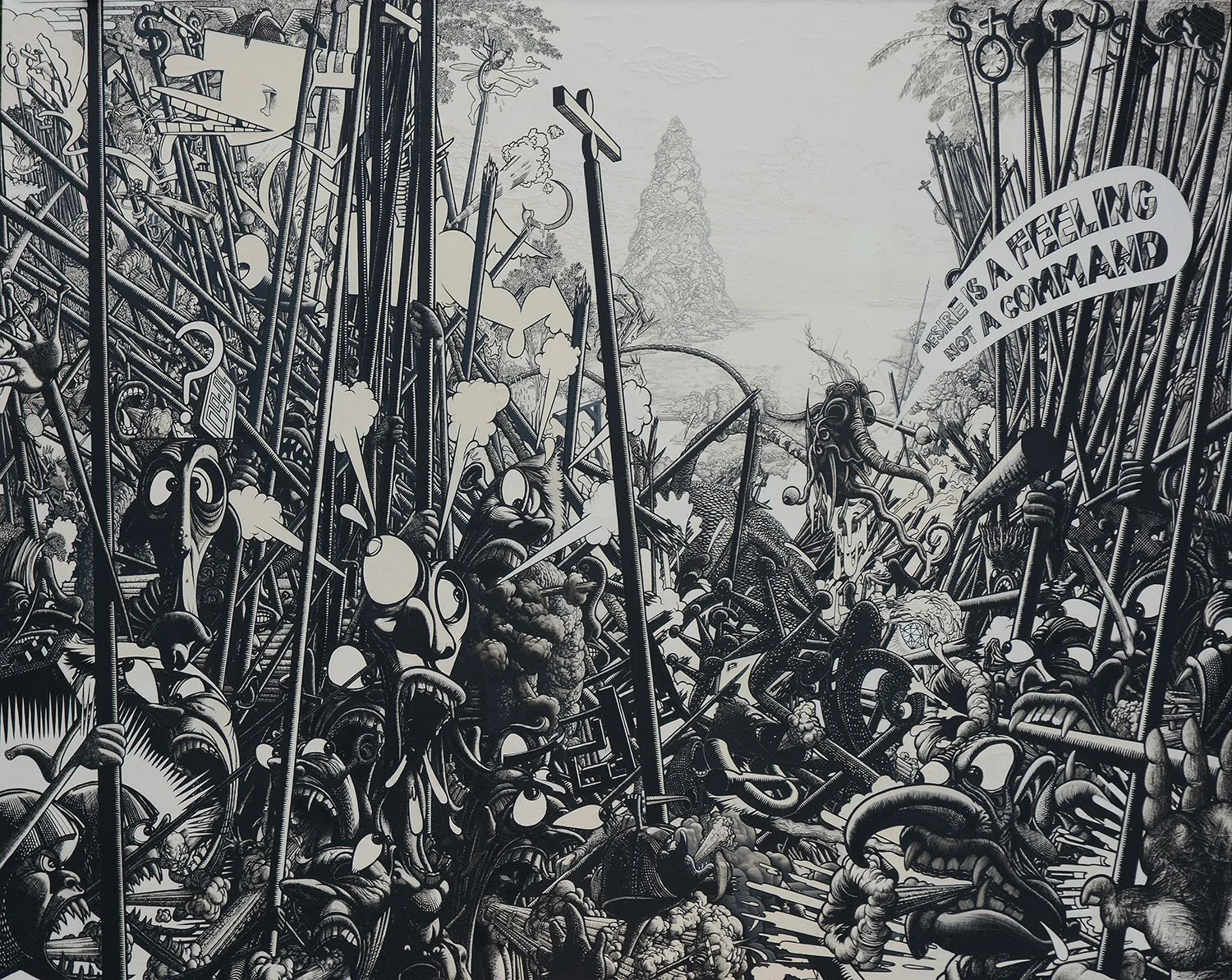
Desire is a feeling not a command, alkyd on canvas, 4’x5’
Jamie had a keen sense of personal freedom and this is clearly reflected in the eclectic variety of his art works. He consistently explored what interested him and what he thought was important rather than sticking to a narrower genre or style.
Jamie refused to be confined to a particular painting style
‘I don't prepare and sketch before I paint. I just face the blank canvas and improvise depending on how I feel. People say my work is chaotic, all over the place, and looks like it was painted by several different artists, but I just paint with all my heart based on how I feel, so there's nothing I can do about it.8’
There was often a tension between figurative and abstraction, and improvisational & compositional strategies
The free jazz that Jamie had espoused in his music had been responsive and adaptive, he was very against being ‘calculated’9 and this often created tension between instinctive play and formal creation in his paintings. He often drew on his experience as a musician comparing improvisational music to improvisation in painting,
‘I have so many ideas. It's about improvising. Consider… the different ways to put the paint on the canvas: some have effects outside our control, I want to include these in my paintings’10.
Yet he also struggled to combine all the elements he wanted. Jamie wanted to throw something in that was ‘outside …control’ yet increasingly he also wanted to include figures that told satirical and humorous stories about politics and human nature. As the following quote illustrates he wanted to be able to work with focus and fluidity,
‘On painting 7/3/11
What’s interesting in painting is the intelligent and decisive application of focussed intention that can be seen and sensed in the trail left behind (footprints) of the stages of its development, mostly of which are in front of you…
a constantly repeated 2 stage process of a burst of painting then a period of assessing the result and how to proceed then – a burst of painting etc’11.
Describing a common process of the intentionality versus the accidental and how an initial image frequently deviates, he admitted he often ended up with a very different image from the one he had intended12. Unconstrained by a particular medium or style, Jamie combined expressive and abstract techniques with figurative elements from drawing. He improvised via abstraction to rid the artwork of composition (as with the ‘poured’ paintings) and added figurative elements, yet often he reflected on the frustrations caused by the tension between improvisational strategies and the composition of figurative works,
‘Sat 19/2/2011
composition was the ultimate killer - it killed off all the pleasure in painting
it encourages you to distrust your natural instincts and impulses
When I introduce compositional concerns too early into a painting – it turns it into a burden – a damaging task. I get stuck in decision – should I keep it or wipe it.
I descend into endless angst ridden thought - and no actual painting.
It becomes theory over practice’13.
One can sense his frustration – a common emotion for those artists who over-think and intellectualise thus blanking out the intuitive focus needed to finish the work. He said in 1991,
‘finishing can be very painful. It's like a battle with myself. I can either decide it's good enough and finish it, or I can feel like it's not and have to redo something. That is painful, but it's also the most interesting part’14.
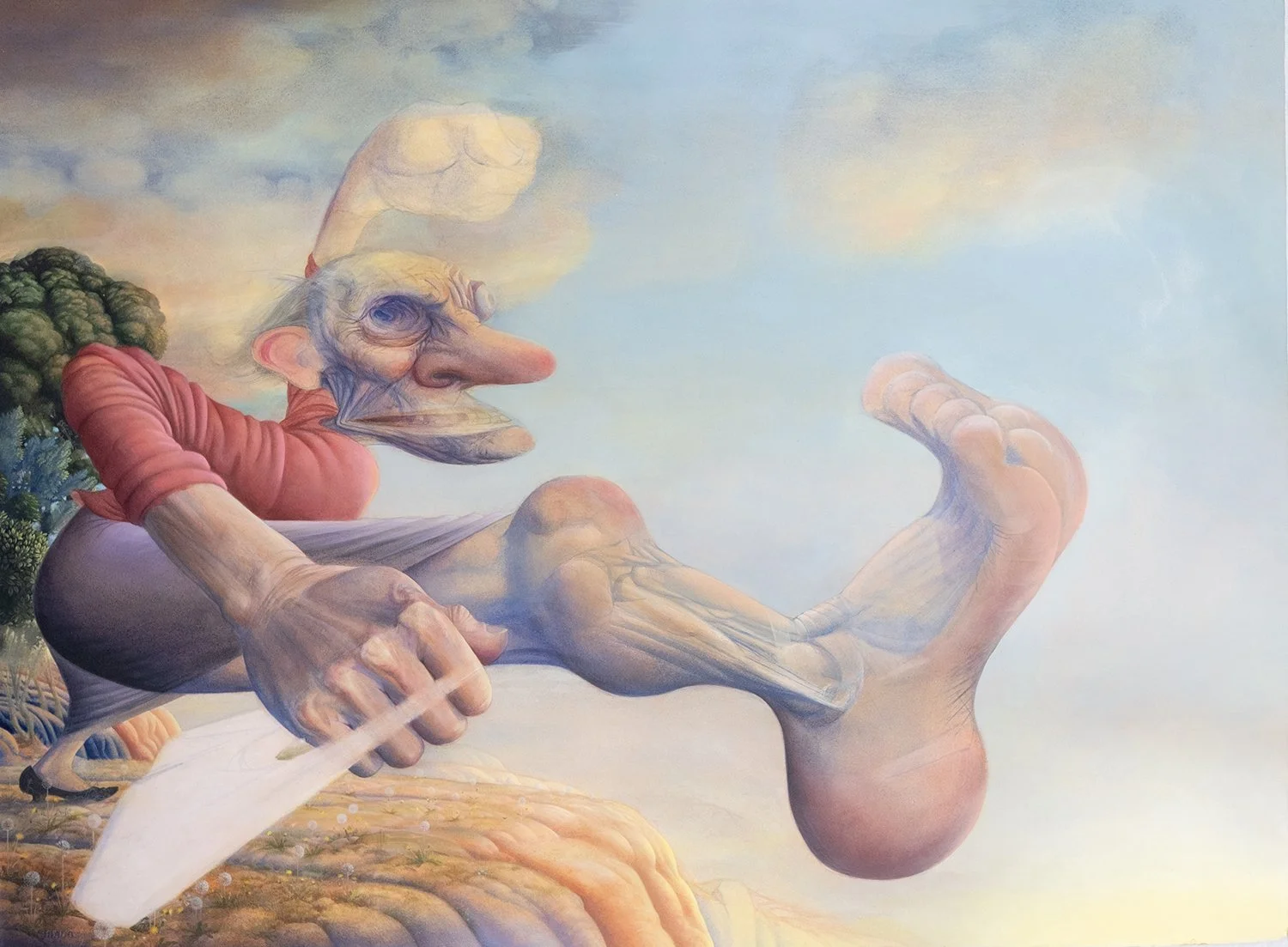
Granny takes a trip, (varied titles noted on back), goucache and coloured pencils on paper, 142x102cm. An example of a later composition
Despite his ambivalence to towards Buddhism, Jamie had an on-going relationship with its teachings throughout his life. He kept in touch with Buddhist friends and referenced Buddhist teachings. He practiced mediation, intermittently visited Buddhist retreats and donated paintings to them.

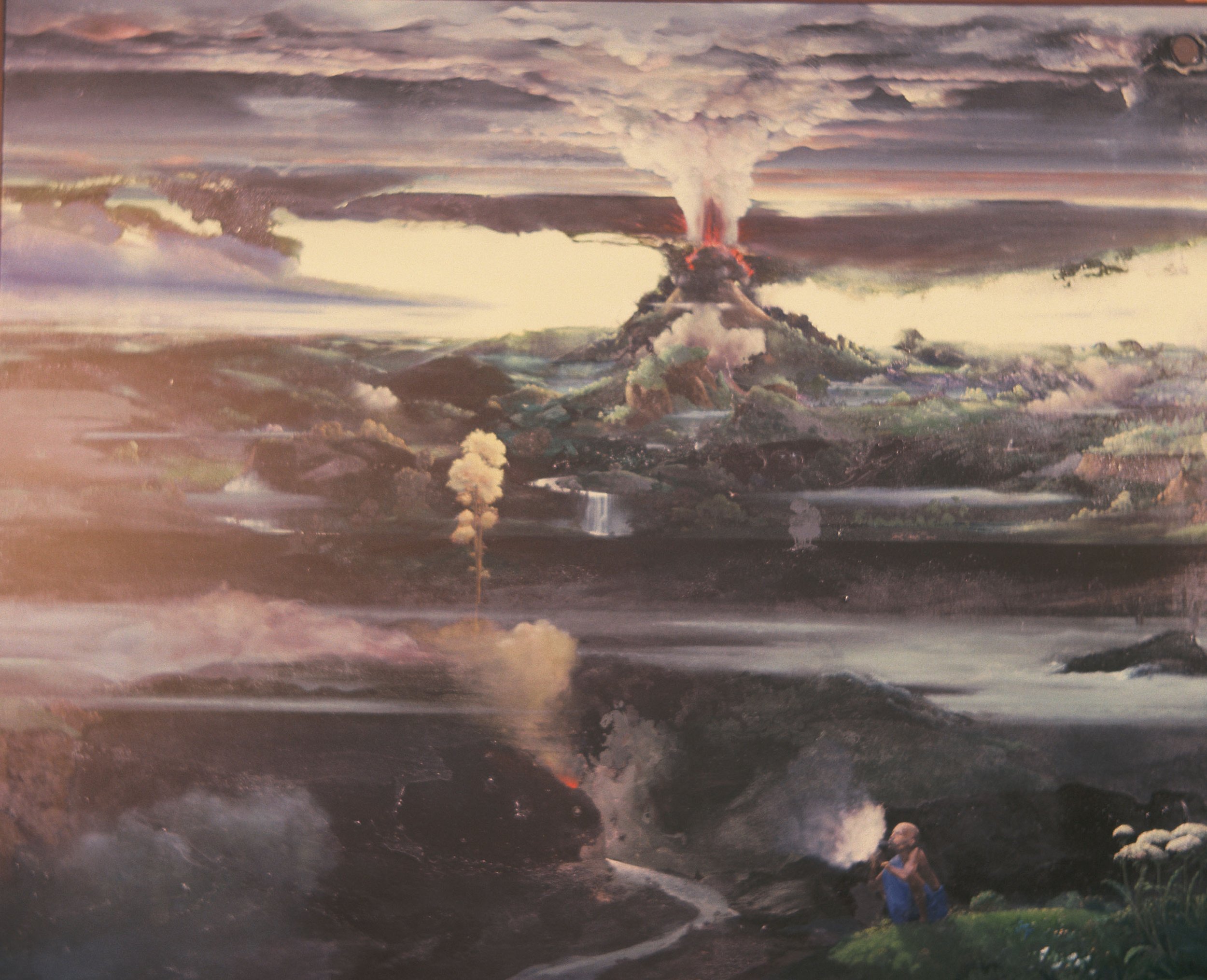
Tibetan Deity and Volcano, both oil & acrylic on canvas, 4’x5’ (1990-1) Donated to a Buddhist centre (unknown location)
In 1998 Jamie sold his property in London and moved permanently to Penzance buying the Lodge in Heamoor, where he alternately worked at home or in a shed in his garden. Jamie showed work at Dick the Dog Gallery, Penzance, owned by friends Maureen and Baz but it seems he rarely sold work, often giving it away if he felt like it. Showing and selling work was not Jamie’s first priority and the only note of sales is from PZ Arts Club, selling a drawing Man with foxhead, staff and rucksack (1999), Such titles as we have vary according to different sources for example this painting
was also noted as ‘young man with staff and rucksack walking’.
Perhaps Jamie never considered titles to be completely fixed, as he was certainly aware of the duality and fluidity of words. Much of his poetry juxtaposes bizarre imagery that reminds you of his paintings. His 1994 poem ‘naming of things’ affirms the abject and random nature of language in connection to objects, and his poem ‘word up’ shows his interest in language and its inadequacy. Undoubtedly Jamie turned to visual imagery as a way of exploring language, and communicating his ideas evocatively. He said,
‘I have a million ideas, and I'm always sketching. I have ideas for more three-dimensional or contemporary works’21.
In his writing Jamie mentions the Buddhist idea of Dharmakya, and he brings this idea of ‘infinite potential’ to the act of painting and the decision making process involved15. He also describes this process in detail,22/5/2019
The period of a few minutes is a reflection of the Buddhist concept of Dharmakaya – infinite potential. The few minutes can involve wiping it off and returning to infinite potential but with a hint of potential direction, which is in the paint residue of paint left behind.
I call this = giving the painting a history16’.
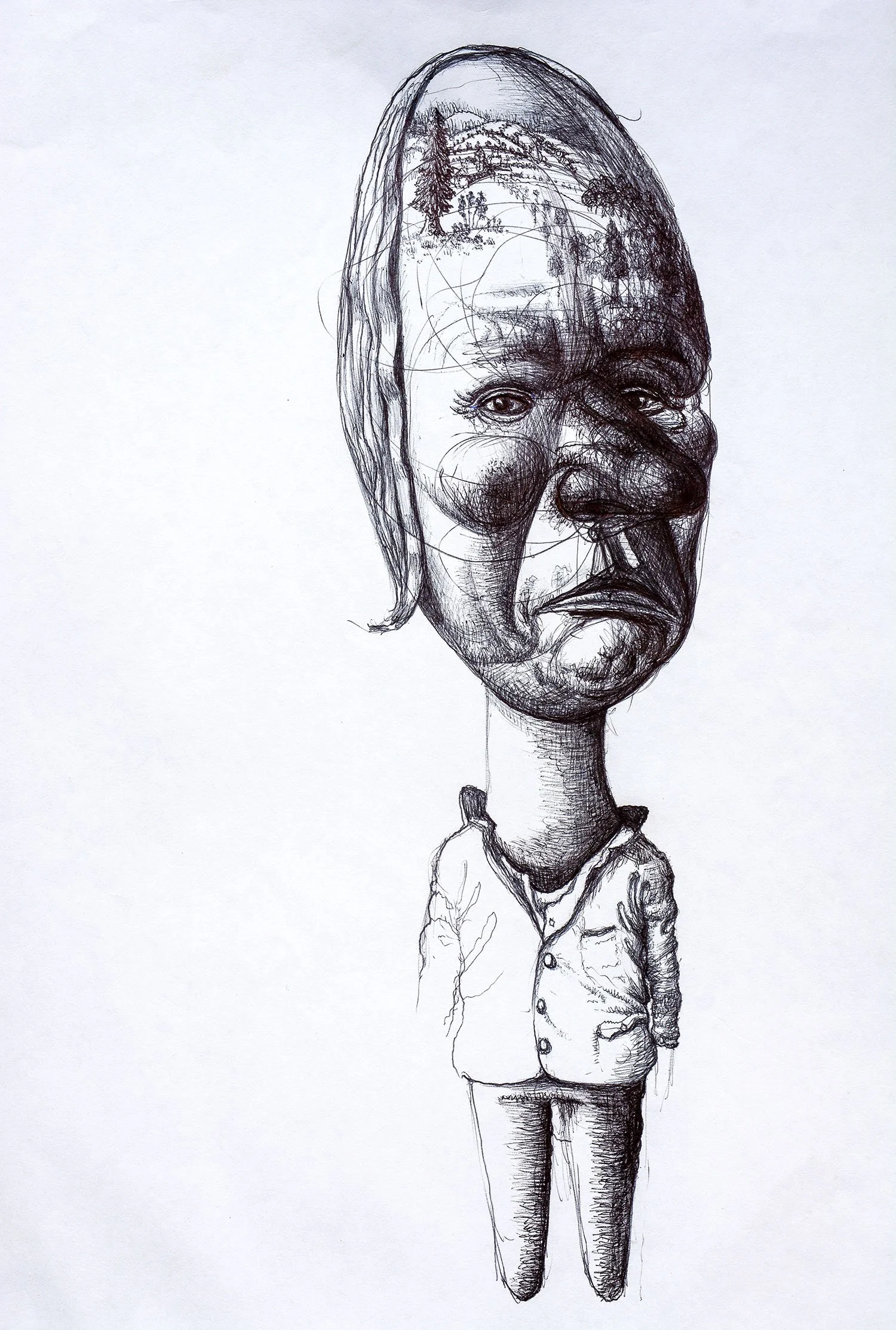
Many paintings and drawings reference a fight between good and evil and if one looks very carefully there are glimpses in distance of what appears to be a Buddhist mandala, ‘a heavenly land, like a mandala opening, garden of Eden, a tree‘17. In one of Jamie’s graffiti-like black and white paintings, Warzone there is such a scene behind the ravages of war. The contrast between good and evil are also personified in many of the ‘cartoon’ characters that he later introduces into his paintings18.
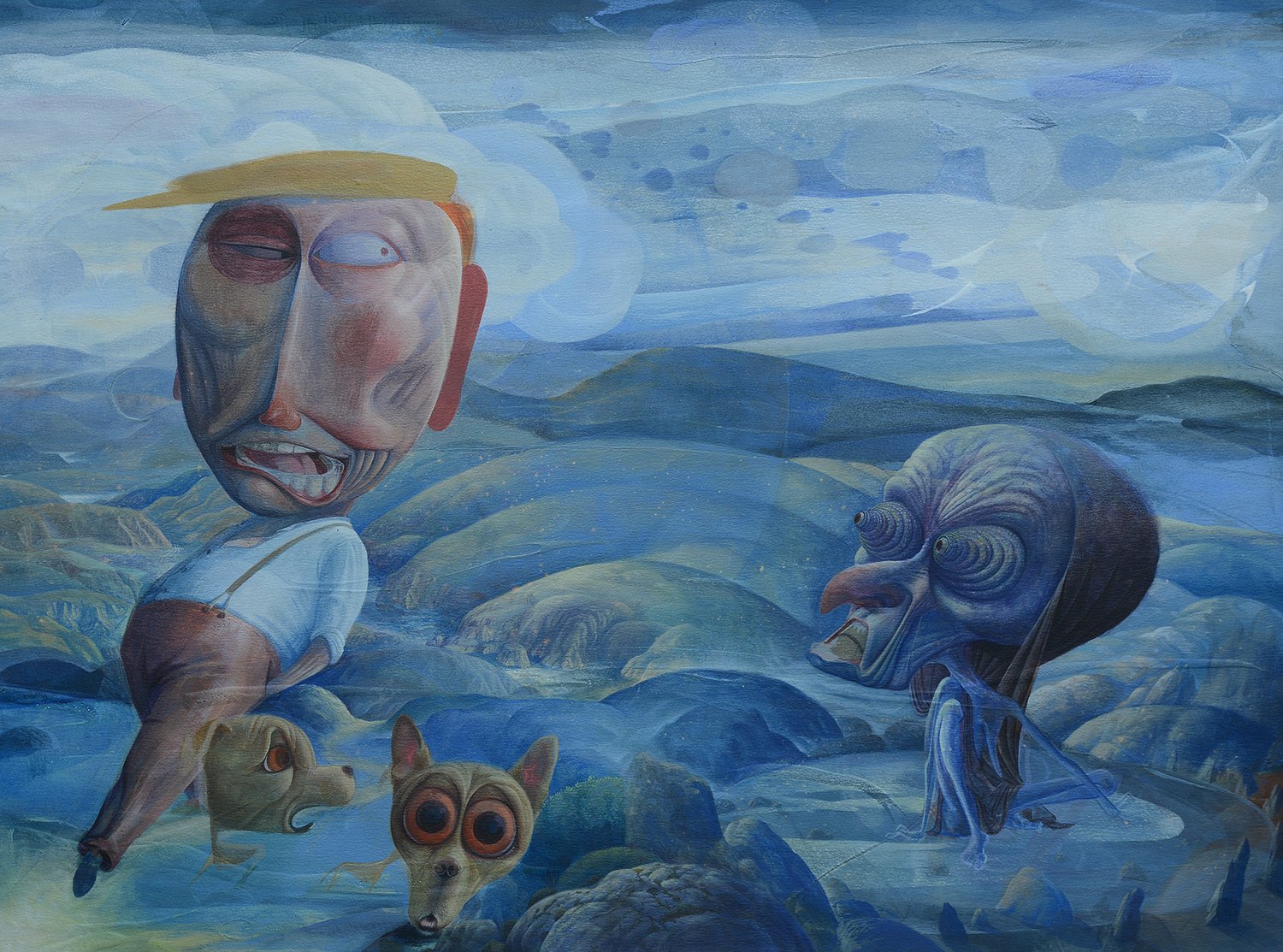
Coy boy with dogs and demon (title unknown), acrylic on paper, 142x102cm
Jamie Muir’s ‘cartoons’
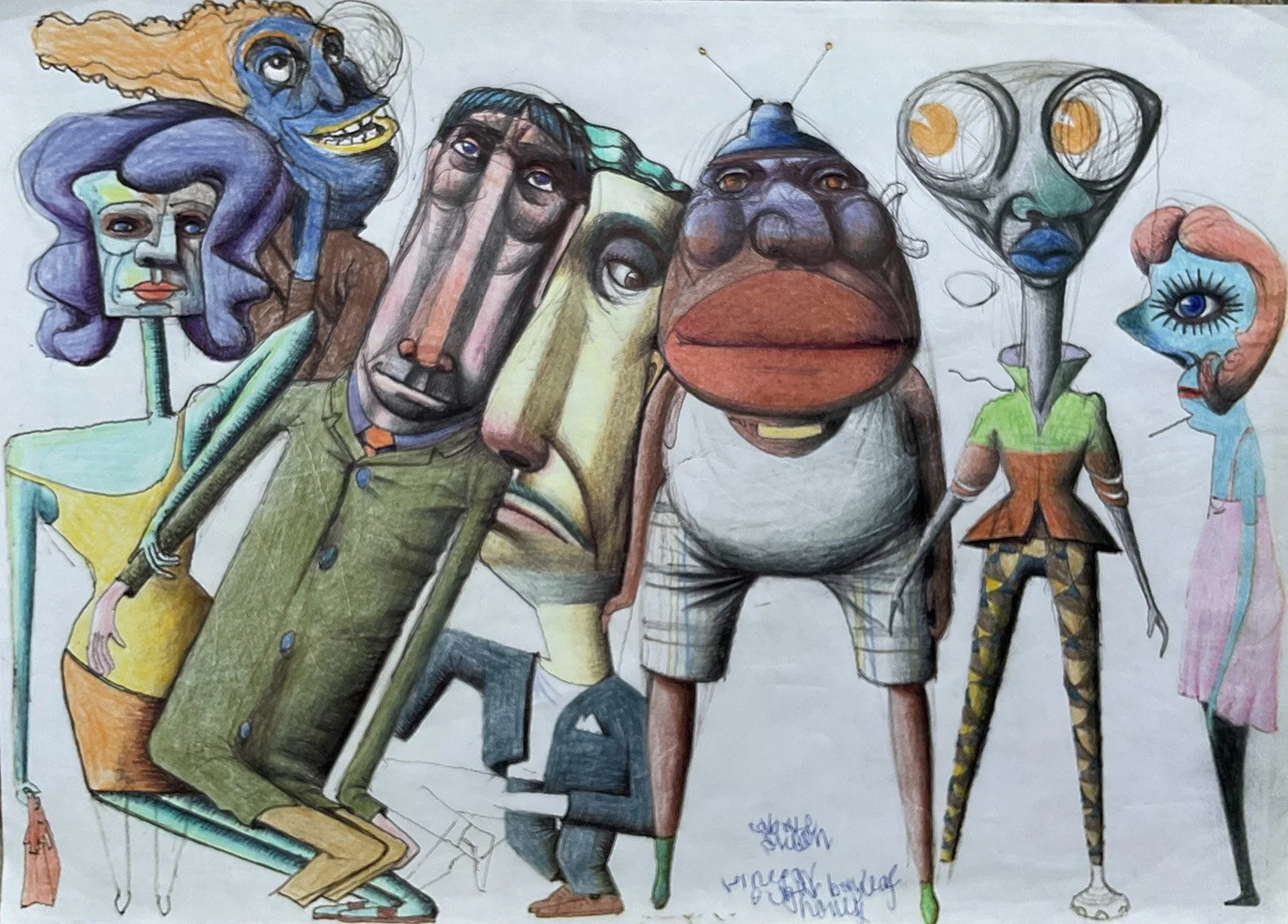
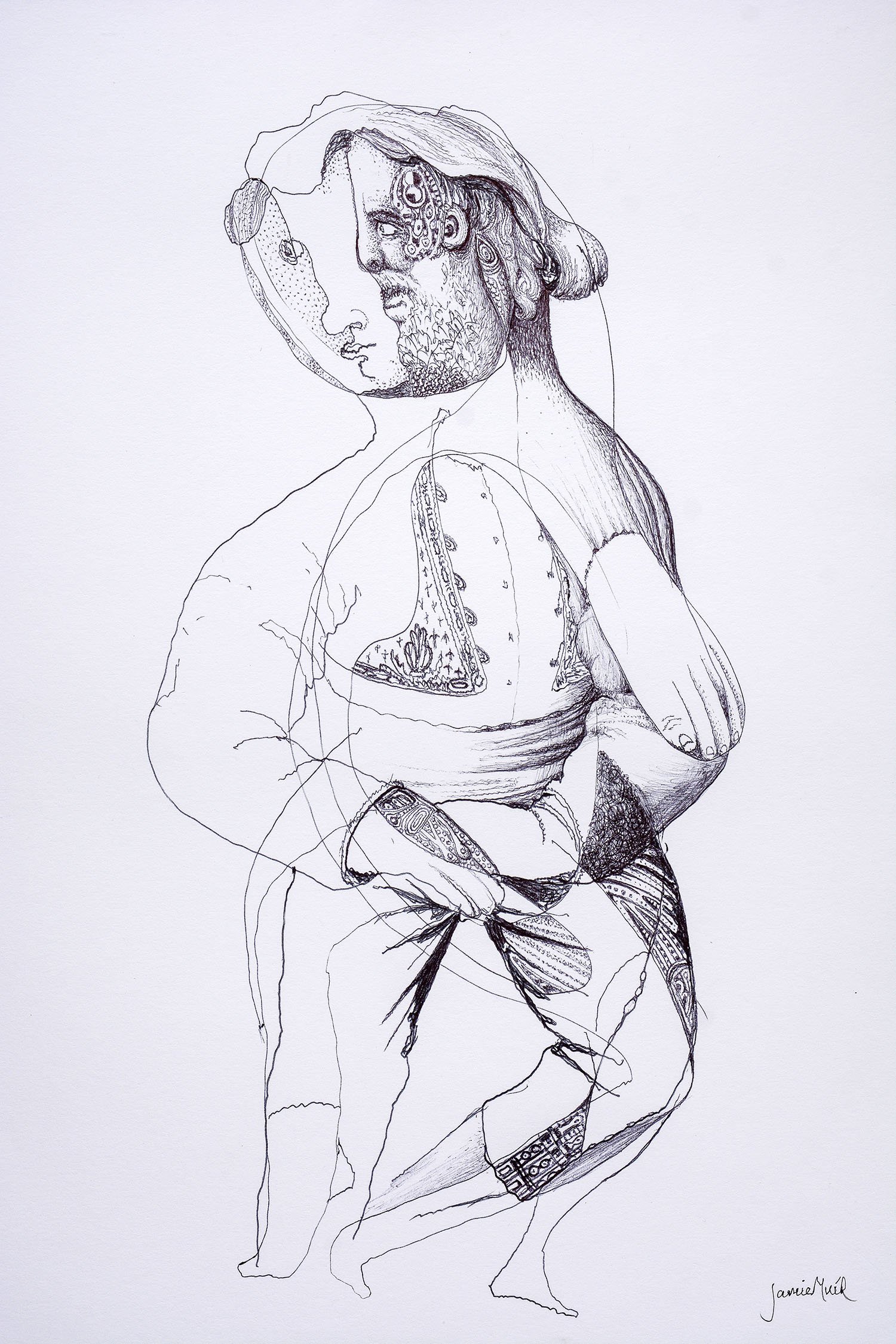
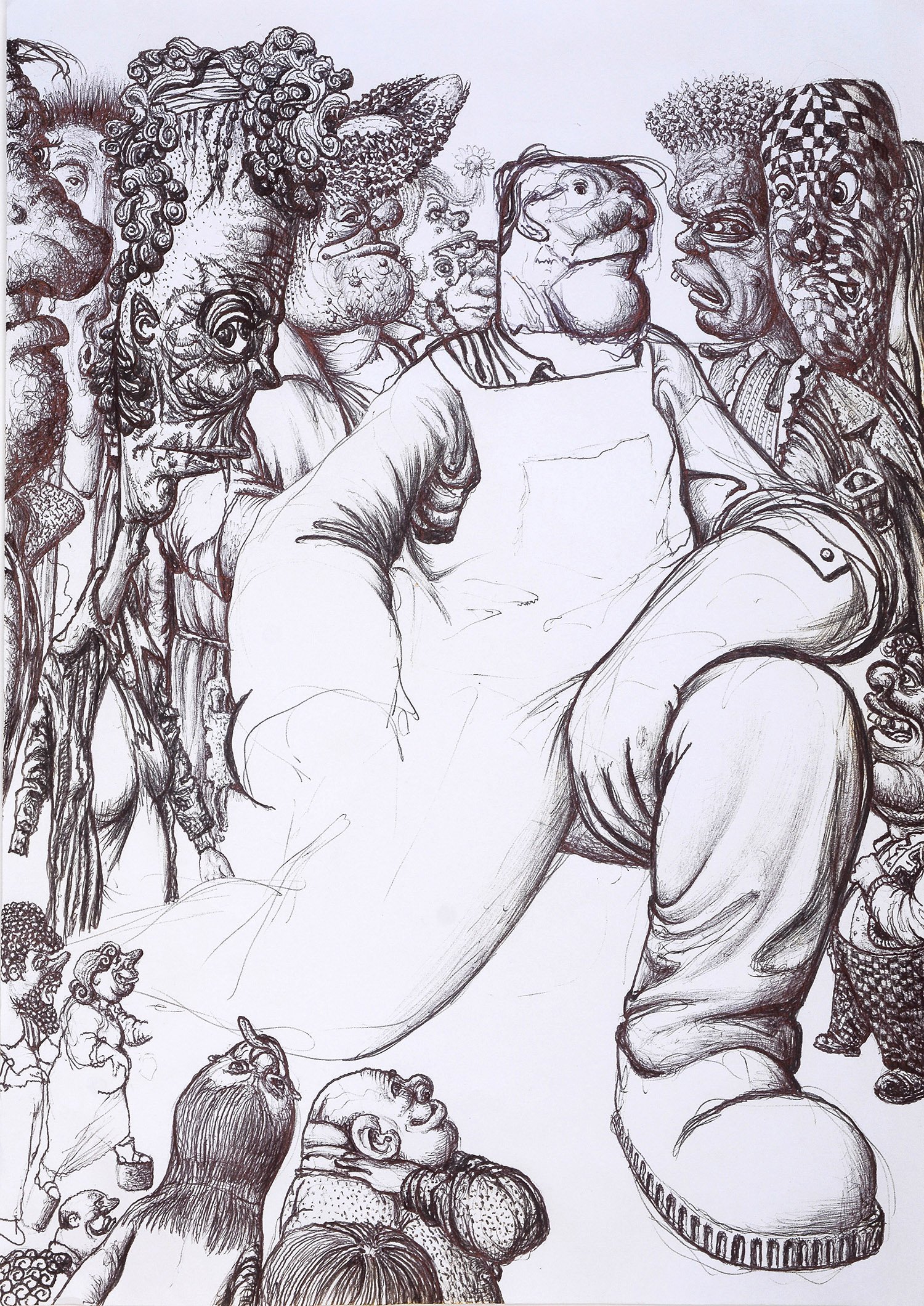
Cartoon Drawings in ink A4
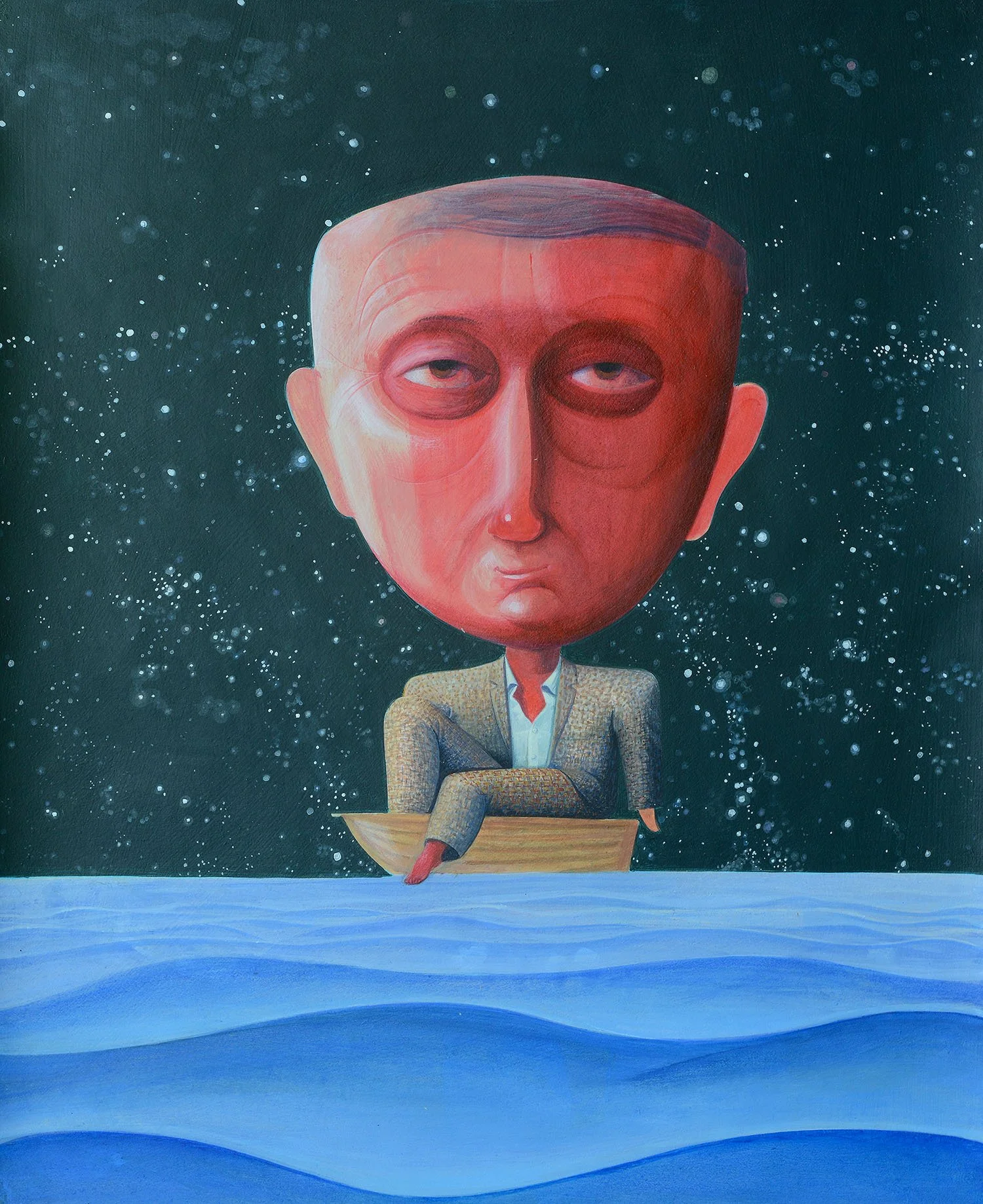
Jamie’s later colourful figurative paintings with their satirical narratives often have characters with enlarged heads. They were often formulated out of a short descriptive sentence and/or developed from ‘cartoon’ drawings. He loved drawing what he called his ‘cartoons’. The volume of work testifies to his ingenuity in developing satirical and humorous characters from doodling and he admits he used these drawings as a way of focussing
I do quite a lot of cartoonish stuff, make it up as I go along. I’m always indecisive, so I was attracted to cartoon style to counteract this’19.
The instantaneous process of drawing closely fitted his ideas about art and improvisation. He also ‘doodled’ abstract patterns and there are many examples of intention and chance intertwined in drawings of figures and abstract line combinations. The figures that flowed from Jamie’s unconscious imagination most certainly explore allegories for the human condition. His ‘cartoon’ people are out-of proportion, accentuating body parts, they have been what Jamie calls ‘media-ed’20, they are comically satirical and relate to the strangeness of the world around us.
Penzance 1998-2025

As his diaries and writings attest, Jamie had a rich inner life. He was interested in everything, and read widely. What is truly remarkable is the range of interests and his conceptual ideas for installations, shows, and multi-media sculpture, which sadly were never made or shown. He confirmed his interest in ‘going beyond the frame’22 by adding blue sculptural cartoon body parts that fit around the edge to one of his black and white paintings in order to give it ‘a comical look’. Jamie collected, jokes, sayings, and ideas for installations, including this humorous one (2009):
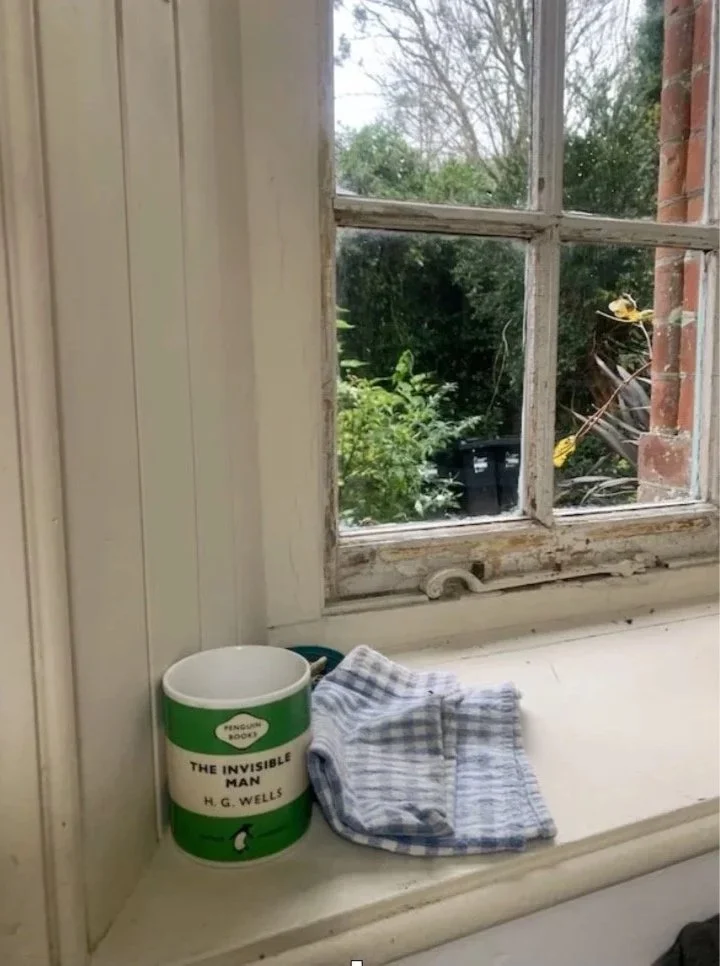
Invisible man mug at Jamie’s House
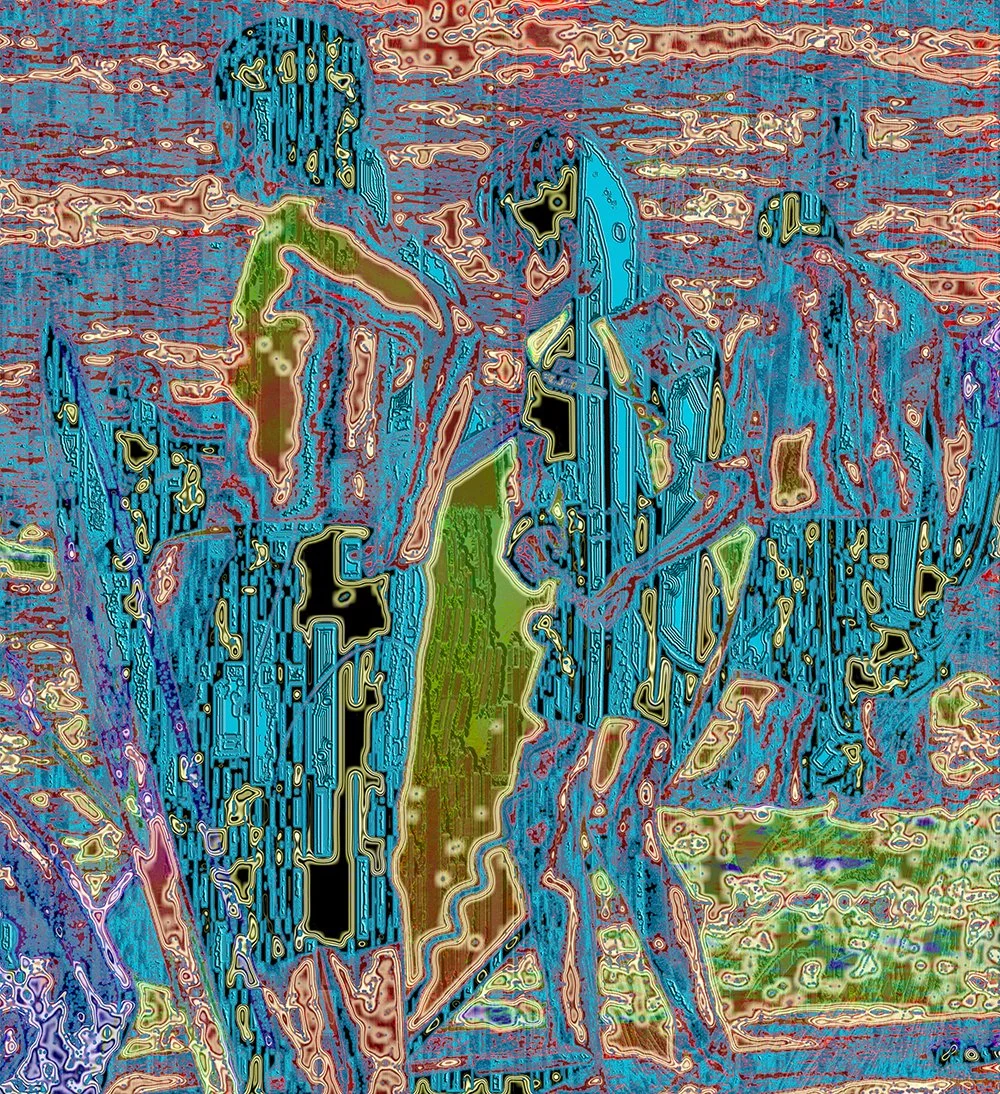
Transforming the Self
There is something chrysalis-like about Jamie as if he was always growing new skins, and vitally interested in journeying and transforming.
‘I come to where I’m going
I go as I’m coming
I come and go equally with the same excitement though
I miss my old skin
till I grow a new one’.30
It is as if he knew that in the process of making art he was also making and re-making himself, a constant endeavour to be better and to see a better world. In one idea called ‘building life,’ Jamie wrote about his drawing process as part of ‘events happening’ and ‘me recovering my balance and continuing to try to build the life I want.’31 Jamie reflected constantly about his motivations and potential, and how he might find a place ‘with scope for transformations.’32
For Jamie there were no distinctions between art and life, both were an unfinalisable process:
‘Recognising your limitations isn’t failing – its recognising that you need a different tool – like putting down the hammer and picking up some sandpaper.
Remember what you’re doing isn’t significant – but the way it changes your understanding of yourself.’33
Jamie Muir’s retrospective exhibition Carry Me Gently Home
During his lifetime Jamie had a conflicted relationship with art markets and selling. He was deeply critical of commercial art and the ‘dark deceitful art of selling’ which he felt re-invented the role of the artist as a merely a supplier, and the buyer simply a collector or investor. Over the years he sold some work and seemed pleased when endorsed in this way, but would more often than not give work away. He was deeply committed to an art practice that with or without an audience he felt had a significant role. He said,
‘real art is anything increases well being – it should heal - make people feel better
Mainly by telling the truth. Truths that other people haven’t got the courage to say’.34
His paintings and art works consistently varied in style and themes, shifting from figurative to abstraction, and often combining the two in unusual ways. He was a questing artist, not content to simply replicate, he was always exploring new territories and ideas, yet also returning to favourite themes and re-working them. It seems Jamie did not paint during the latter period of his life, he suffered from a common complaint of many artists who stop making because of over-thinking. Jamie seemed to acknowledge this when with some humour he referred to himself as a ‘Thinkopath’ (2023).35 Yet Jamie never entirely stopped working, he constantly played with digital imagery, and was always to be found drawing ‘cartoons,’ right up to the very end of his life. These drawings bear testament to a hugely vivid imagination and a stream of ideas that would not be stilled.
During the process of reading Jamie’s notebooks and archive one can feel his ingenuity, warmth and intelligence and he could always surprise and move you with the simplest of statements or visual images. The last page of one of his notebooks simply says,
‘carry me gently home’.36

Author’s notes
Whilst wondering whether to refer to Jamie Muir in the formal art writing tradition of ‘Muir’, I found that after researching deeply through his archive I felt I had got to know him and that it was only fitting that I called him ‘Jamie’.
It is always difficult to making sense of an artist’s oeuvre, due to gaps and omissions, especially when they are no longer with us. Jamie Muir kept detailed notes yet did not date his paintings and art works. This is merely a preliminary foray into Jamie’s world via his archive. There is still much work to be done to certify dates of paintings and titles, and discover Jamie’s changing and developing interests in drawing, painting, photography and digital work, and conceptual installation.
Despite every effort to be objective and quote directly from Jamie’s writings there will necessarily be some subjective and personal observations that are designed to direct the reader towards some of Jamie’s ideas discovered during the research period but it is hoped these will not tamper with an audience’s ability to form their own opinions about his creative output. You will note that there is an emphasis on painting and drawing because of material available in the archive in which Jamie writes primarily about painting, and drawing and the sources that are available and quoted are primarily from c.2005-2016.
ENDNOTES
1 Jamie Muir Purple Ideas folder 2009-2013
2 Issac Donnithorne’s interview with Jamie Muir for the Heamoor Herald 2022
3 Jamie wasn’t thinking about doing music, but a friend suggested it. One of the
recordings he made was the album Dart Drug (1985) with Derek Bailey, He had also
met Lyndsey Kemp through friends and had a gig with him and Jack Burket in East
Grinstead. List of friends and life events 2006
4 Jamie studied at Edinburgh School of Art 1966 but didn’t finish his studies in FineArt
5 Jamie Muir interview with Matsumoto Masayuki for ‘Marquee’ Japanese music
magazine, 1991, published 1992
6 Jamie Muir red accounts notebooks
7 Jamie Muir Purple Ideas folder 2009-2013
8 Jamie Muir interview with Matsumoto Masayuki for ‘Marquee’ Japanese music magazine, 1991, published 1992
9 Jamie’s view of percussion was inspired by Milford Graves…. ‘its not about learning how to do what someone else is doing but how you respond to what other people are doing. It’s reducing it to a spontaneous response not a calculated one’. Quoted inJamie Muir interview with Matsumoto Masayuki for ‘Marquee’ Japanese music magazine, 1991, published 1992
10 Jamie Muir interview with Matsumoto Masayuki for ‘Marquee’ Japanese music magazine, 1991, published 1992
11 Jamie Muir Blue Box of Ideas c.2005-2020
12 Full quote:
‘I do paint representational pictures too. But even if I have an initial image, once I start painting, it gradually deviates from the original idea, and a different image emerges, so it ends up being completely different from what I had planned.’ Jamie Muir interview with Matsumoto Masayuki for ‘Marquee’ Japanese music magazine,1991, published 1992
13 Jamie Muir Blue Box of Ideas c.2005-2020
14 Jamie Muir interview with Matsumoto Masayuki for ‘Marquee’ Japanese music magazine, 1991, published 1992
15 Full quote:
‘More precisely potential is being rapidly converted into an increasingly specific dualistic situation bringing with it all the tensions of choice of decisions and their consequences, and always the goal is to shepherd it to a point where it has a depth and interest that gives it a vitality of presence of life that can stand on its own’. Jamie Muir Blue Box of Ideas c.2005-202017
16 Jamie Muir Diaries 2019-23
17 Jamie Muir Blue Box of Ideas c.2005-2020 Full quote: ‘a man’s head – me - an inch or so above eyebrows it is chopped off and replaced by a heavenly land, like a mandala opening, garden of Eden, a tree, etc’
18 Jamie’s brother George calls these heavenly scenes ‘sunlit uplands’. George also suggests the possibility of other Buddhist influences at work in Jamie’s paintings, perhaps the practice of CHOD, a meditation that includes prayers that take on all the evil spirits in the world. This is something that Jamie described in a letter to his family (c1979)
19 Issac Donnithorne’s interview with Jamie Muir for the Heamoor Herald, 2022
20 ‘cartoon idea 20/2/11
cartoon people – each of which has part of their body very enlarged - they’ve been ‘media-ed’ - it puts things out of proportion - balance
NB the magnifying glass effect over part of a face’
Jamie Muir Blue Box of Ideas c.2005-2020
21 Jamie Muir interview with Matsumoto Masayuki for ‘Marquee’ Japanese music magazine, 1991, published 1992
22 Jamie Muir Purple Ideas folder 2009-2013
23 Jamie Muir Purple Ideas folder 2009-2013
24 He didn’t really stay in touch with old or new music scenes with the exception of a visit to London in 2022, where he said he enjoyed going to London for the release of the King Crimson documentary. Issac Donnithorne’s interview with Jamie Muir for the Heamoor Herald 2022
25 Richard Williams, Jamie Muir Obituary, The Guardian, 27/02/2025
26 Jamie Muir Blue Box of Ideas c.2005-2020
27 Another such idea:
17/8/10 ‘photo’ idea
The piece is a big blank image with this wriKen in the middle
‘where I go - I’m always there’
Jamie Muir Blue Box of Ideas c.2005-2020
28 George Muir’s research about Jamie and his book about his wife Bonnie that has and texts about Jamie’s work.
29 Issac Donnithorne’s interview with Jamie Muir for the Heamoor Herald 2022
30 Jamie Muir Purple Ideas folder 2009-201318
31 Full quote:
Idea 2//3/11
‘building life’
a bit of spontaneous paint then in my careful doodling with patterns . The repeating thing plus other..
then another spontaneous paint event – partly concealing my doodles then my doodling out of that – etc-
so..
the constant back and forth/exchange between..
-events happening
-me recovering my balance and continuing to try to build the life I want ‘
32 Full quote ‘my enduring attraction to the thing that I ‘m told I shouldn’t like and the things no-one else is interested in, attracted for good reasons. It’s a place I can be without having to fight for it. I’m not competitive but it’s also a place with scope for transformations’. Jamie Muir Blue Box of Ideas c.2005-2020
33Jamie Muir Purple Ideas folder 2009-2013
34 ‘Statement about art’ Jamie Muir Blue Box of Ideas c.2005-2020
35 Jamie Muir Diaries 2019-23
36 Jamie Muir Diaries 2019-23
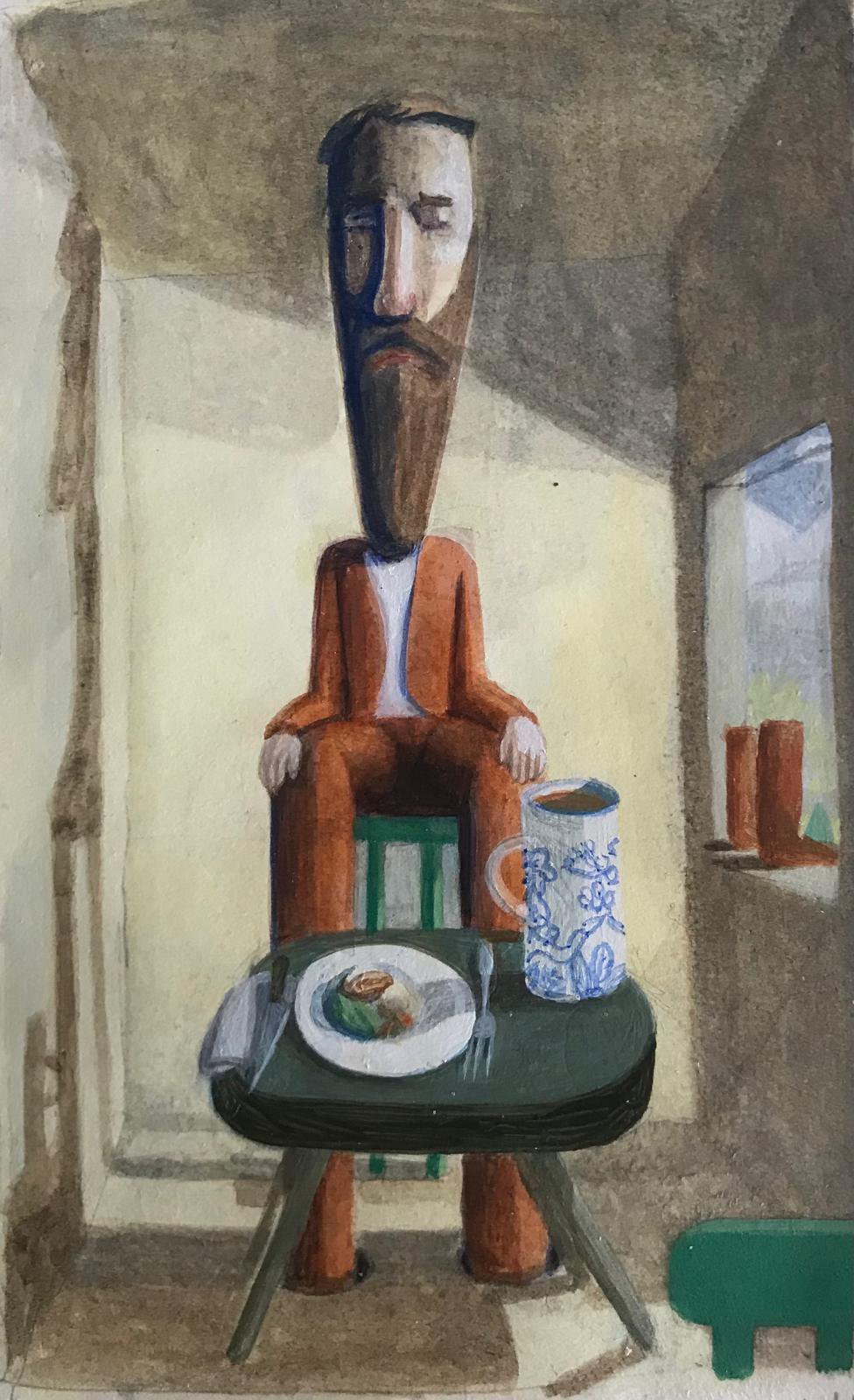
Tall man saying grace, gouache on paper, from sketchbook, approx. 15x10cm
‘IDEA FOR ‘BOTTOMS’ (installation)
the bottom of things
the bottom of half a table
a chair
an electric toaster
a painting framed’.23
Presence and performativity
Jamie never expressed regret about leaving King Crimson but must have often found it frustrating that his earlier (and continuing) fame for what was a brief moment in his life seemed to subsume his continuing creative life. In interviews he expressed frustration about people only wanting to talk to him about the past and not the present.
Jamie had once been compared to a ‘performance artist,’ 25 and it is interesting that many of his ideas are performative and interactive. These are examples of some of the conceptual ideas that he wrote down:
‘A chair taped to the floor and people walking in on logs’ (2012)
‘The spitting wall – a copper sheet that invites everyone to spit on – that turns green 26
He may never have made, completed or showed these installations but they exist as almost ‘scores’ ready for a player to play or perform them.
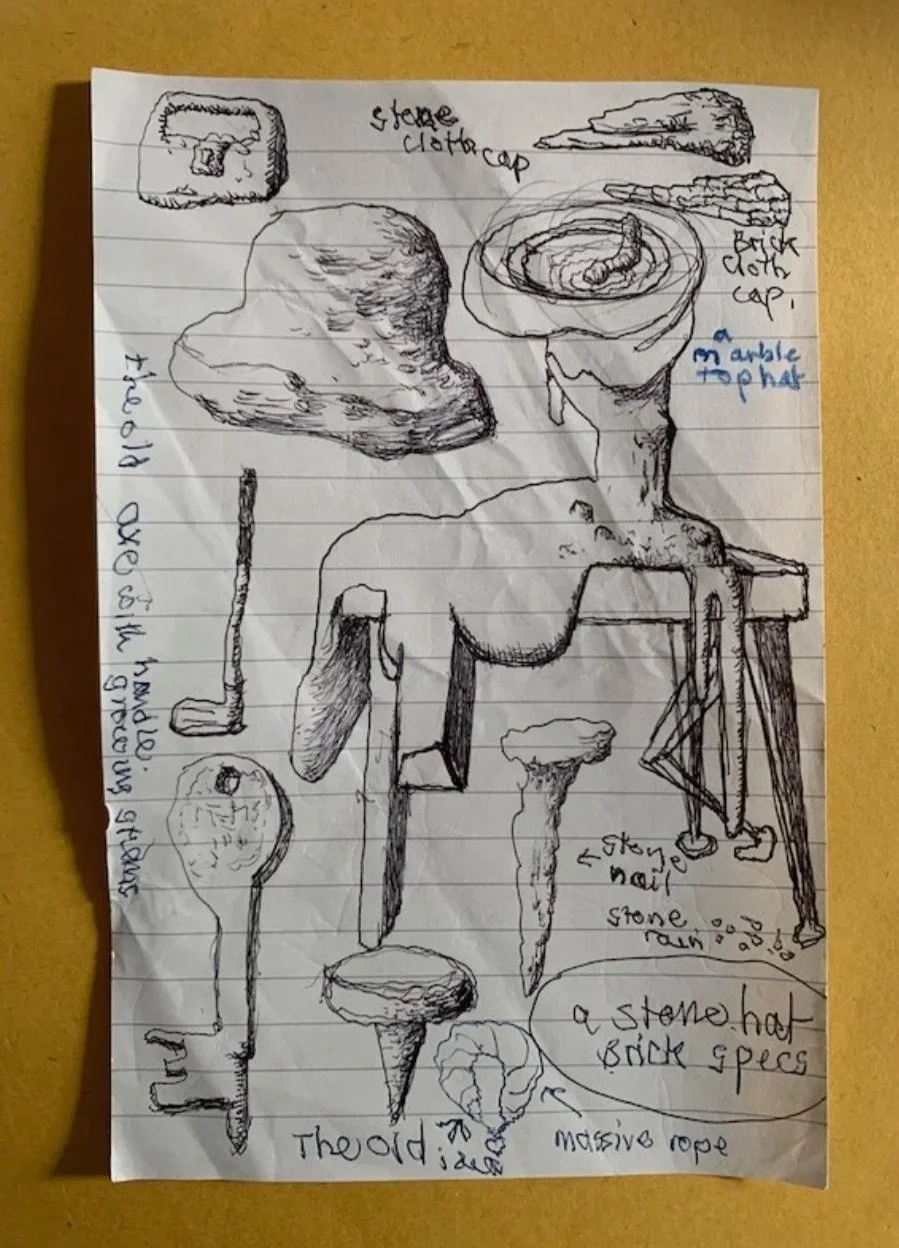
A design for ‘stone hat and brick specs’ from one of Jamie’s ideas folder
In contrast to installation ideas that required presence, Jamie often wrote about invisibility and noted ideas that centred around the idea of presence:
‘17/8/10
As a preliminary to a show’ I’m not here’
Send letters to random people that say ‘I’m not here’ plus stickers graffiti
Take out adverts – like another slick shallow ad campaign
Lots of small ads
Evoke a cynical reaction’.27
Photography and digital art works
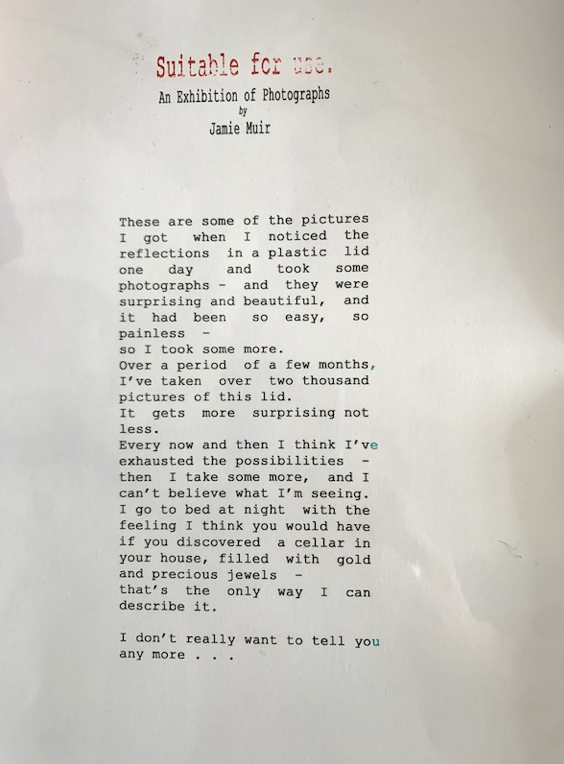
Despite educating himself through his wide reading, Jamie expressed sadness and frustration about his lack of art education and cites his experience of expulsion from Edinburgh Art School as traumatic. His keen interest in photography is a thread that runs throughout his work, as is his desire to master new technical abilities. From 2008-2010 he enrolled in a course at Truro Photography FdA, becoming an adult art student aged 63. His work showed a startling attention to detail, and displayed his desire and commitment to engage with new ideas. He was keen to try new things out, and resist rules, hierarchies, and expectations. His FdA degree show introductory text seems to sum this up:
Jamie’s photographs were often of people, and local scenes. Jamie learnt new programmes and digital art interfaces so that he could experiment with new ways of re-working and playing with new and old imagery. In his writing about digital work he referred to it as a kind of ‘digital pointillism’ and also ‘blingism’ 28 where the every day object (in this case the view over to St Michael’s Mount) is changed almost beyond recognition by digital processing, inviting the viewer to see objects and things differently.
Jamie’s return to previous or existing material often provided a focus when he no longer felt he had enough space to paint, or he found difficult to finish work. There were always infinite variations to be made at a press of a button, ‘I always ran out of patience before I could get anything finished…. With image processing I’ve got lots of finished stuff, sometimes starting with photos and more recently my own artwork, then putting it through heavy processing.’29